01
O6 Arc
Continuous intelligence
Capture and connect the right signals across your data, your tools and your people — continuously, not once a quarter.
The systemApplied intelligence. Real impact.
O6 Applied builds intelligent systems and automations that eliminate manual work, capture the opportunities you are losing, and drive measurable growth.

O6 principle / 001
Technology becomes valuable at the moment it changes an outcome.
The systems
O6 works across
The O6 point of view
O6 looks beneath the surface problem, maps the workflow, finds where intelligence creates leverage, and applies it at the point where the outcome changes.
O6 Arc
Capture and connect the right signals across your data, your tools and your people — continuously, not once a quarter.
The system
O6 Cut
Design and deploy automations that remove friction, enforce consistency and free the team to spend its judgment where judgment matters.
The actionO6 Signal
Track the outcomes that matter — time, money, speed, capacity — so the system can be proved, tuned and scaled with confidence.
The impactSample system output
Case / 014 · one lead-recovery build · first 30 days
Figures describe one implemented system over one month. They are an illustration of what a single build produces — not a firm-wide or client-portfolio claim.
The O6 operating layer
From signal to impact, the O6 layer unifies data, automation, conversations and outcomes — so the business runs as one system instead of eleven disconnected ones.
Concept preview · sample data
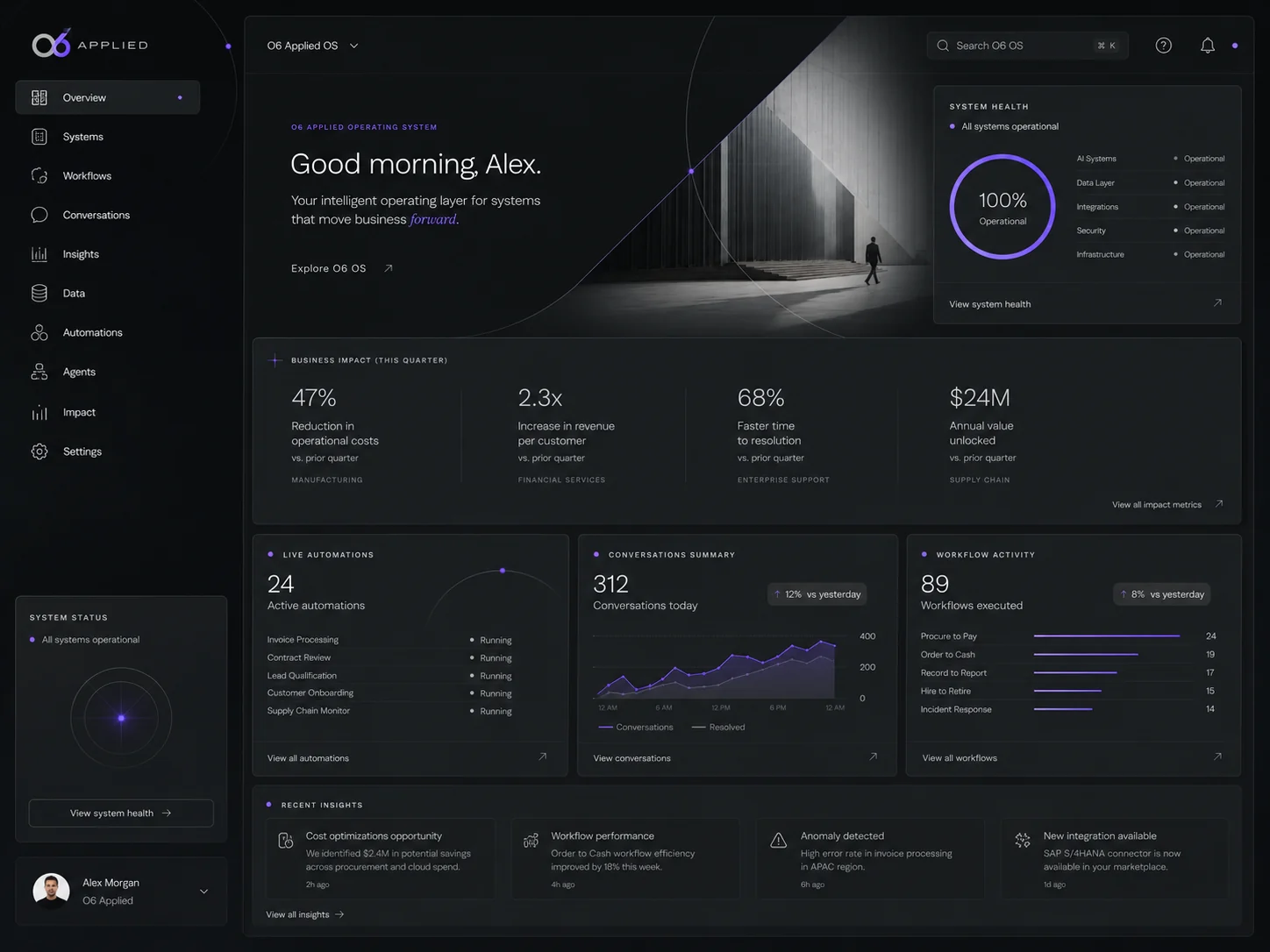
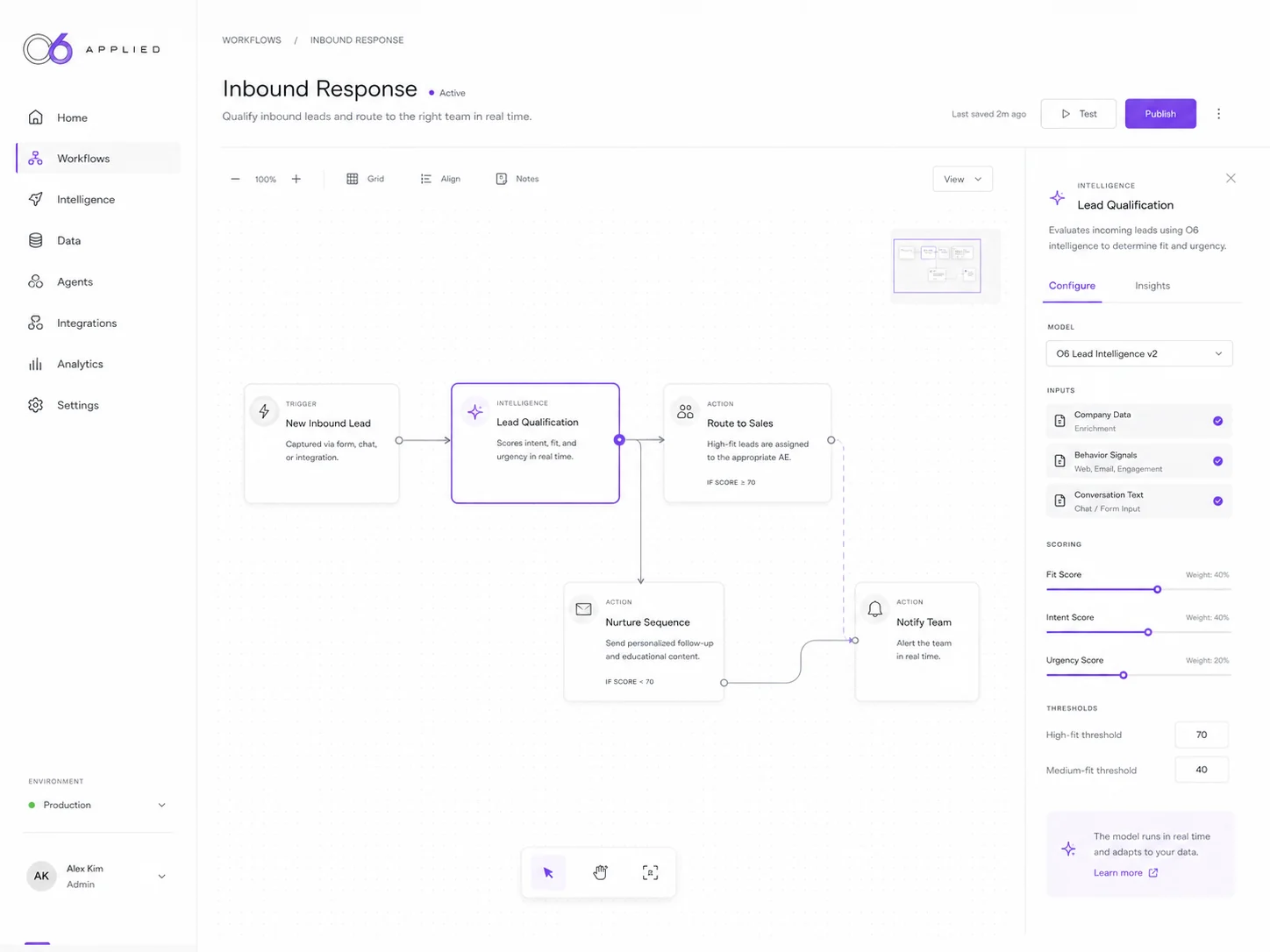
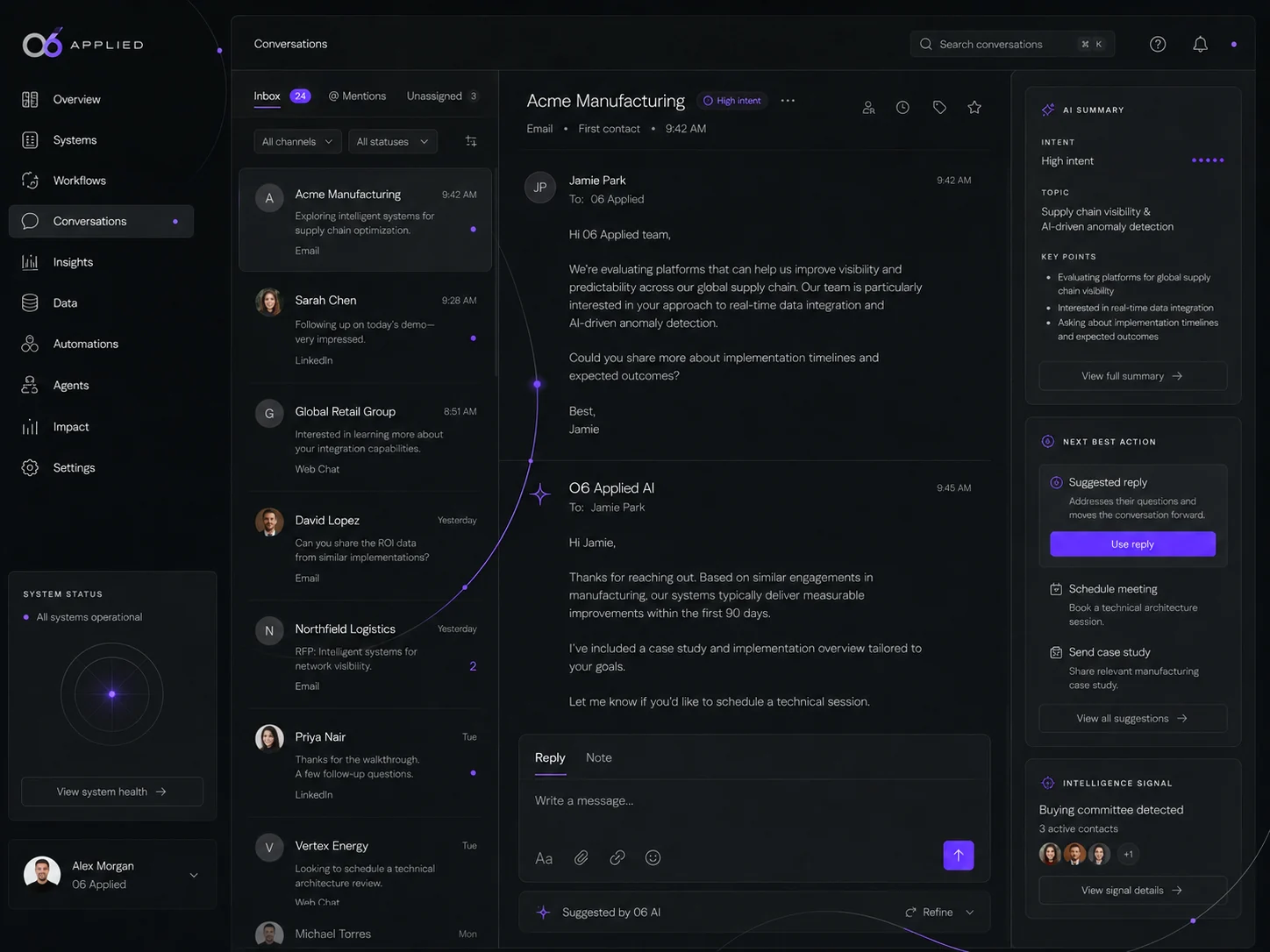
Automations, conversations, workflows, signals and impact in one place. The operating layer adapts around the systems a business actually needs — nothing more.
These are design concepts rendered with invented sample data — including the figures, company names and account shown inside them. They are not screenshots of a shipped product, and they do not describe any client's results.
What we build
AI, automation, software and process design, combined into systems the people in the business can actually operate.
01 / Response
Lead capture, missed-call recovery, qualification, routing, follow-up, booking, reminders, CRM updates and a clean handoff to a human at the right moment.
02 / Operations
Connect the tools, kill duplicate entry, automate the handoffs, keep work moving.
03 / Intelligence
Search, summarise, analyse and surface the context at the moment of the decision.
04 / Software
Internal tools, portals, dashboards, operator views and customer-facing workflows.
05 / Systems
One layer across data, tools, automation, agents and people.
The method
A big vision becomes precise execution through a short, repeatable operating sequence.
01 / See
Understand the workflow, the customer journey, the data, the constraints and the objective.
02 / Design
Choose the right mix of AI, automation, software, integrations and human judgment.
03 / Build
Connect the tools, create the interface, automate the handoffs, deploy the intelligence.
04 / Transform
Measure the outcome, refine the system, compound the leverage across the business.


Why O6 exists
O6 Applied grew out of years of thinking in systems, taking emerging technology apart and building custom solutions firsthand. That work quietly expanded what a single person could design, ship and operate.
The next step was simple: turn that leverage outward. Build systems that help other businesses reduce friction, capture opportunity, create capacity and move with more intelligence than the day before.
We identify where intelligence creates leverage. Then we apply it.
Field Notes
Observations, system maps, breakdowns and principles for owners who want practical ways to put emerging technology to work.
Observation / 001
Response time, qualification, routing, follow-up and scheduling usually decide whether demand turns into revenue — long before anything on the marketing side does.
System / 001
A practical architecture for turning inbound intent into immediate action.
Principle / 002
A simple boundary for deciding where intelligence belongs inside a workflow.
Common questions
What business owners want to know before starting a conversation about automation — including the parts most firms are vague about.
We build systems that do work a person is currently doing by hand. In practice that means answering and qualifying inbound enquiries, recovering missed calls, moving data between tools that don't talk to each other, automating follow-up and scheduling, and building the dashboard or internal tool that doesn't exist yet.
The technology varies. The job is always the same: find where the business loses time, money or opportunity, and change that specific outcome.
We price against the value of the outcome, not hours. A system that recovers enquiries a business is currently losing is worth what those enquiries are worth — and that number is different for a roofing company than for a dental practice.
So the first conversation is a diagnosis, not a quote: what happens today, how often, what it costs. You get a written scope and a fixed price before any work starts. Most engagements combine an implementation fee with a monthly fee for running and improving the system.
What we won't do is quote before understanding the problem. A number given in the first ten minutes is a guess, and guesses get corrected later at your expense.
Almost never, and we'd push back if someone suggested it. Most businesses don't need more software — they need the software they already pay for to be connected and actually used.
The usual work is integration: your CRM, phone system, calendar, accounting tool and inbox behaving as one system instead of five islands with a person copying between them.
Zapier and similar tools are genuinely good, and if a two-step automation solves your problem you should build it yourself and keep the money. We'll tell you when that's the case.
The difference shows up when the process has judgment in it, spans several systems, has to handle exceptions, or needs to keep running when something changes upstream. And unlike a contract developer paid to build what you specified, the work starts with deciding what's worth building at all.
Small and mid-sized businesses where a real amount of money moves through a manual process. Accounting and bookkeeping firms, home services and trades, professional services, medical and dental practices, real estate, construction, and B2B service companies.
The common thread isn't industry. It's that inbound demand or internal coordination is being handled by people doing repetitive work.
By what it costs you not to. We map the process, find where it breaks, count how often, and put a number on it. The first build is whichever intervention changes the largest number for the least complexity.
The rule we work to: automate repetition, preserve judgment. If a step needs a human decision, it keeps one — the system just makes sure that decision happens fast, with the right information in front of it.
A focused system — missed-call recovery, inbound qualification and routing — is usually live in weeks, not months. Larger work is deliberately staged so something useful runs early rather than everything arriving at the end.
The scope and the dates are written down before work starts.
Systems that touch live customer enquiries need someone accountable for them, so most engagements include ongoing support and monitoring. That's stated in the scope with what's covered and what response looks like — not left as an assumption.
We also build so that a failure degrades rather than disappears: if an automated step can't complete, it surfaces to a human instead of silently dropping.
Both. The build work is remote — that's simply how software is made. For discovery, mapping how a business actually runs, and handover to the people who'll use the system day to day, we work on-site with clients across Maryland, Washington D.C. and Virginia.
Send a short description of the bottleneck, the repetitive process, or the thing you keep wishing your systems could just do. You get a written read on where the leverage actually is — before anyone talks about building anything.
Email hello@o6applied.com. If there's nothing worth building, we'll say so.

Applied intelligence. Real impact.
Bring the bottleneck, the repetitive process, the missed opportunity, or the thing you keep wishing your systems could just do on their own.
Start the conversation